invoice-organizer
Verifiedby ComposioHQ · Updated Apr 16, 2026
Automatically organizes invoices and receipts for tax preparation by reading messy files, extracting key information, renaming them consistently, and sorting them into logical folders. Turns hours of manual bookkeeping into minutes of automated organization.
See It In Action
Let me first look at what's in the working directory to understand what we're working with.
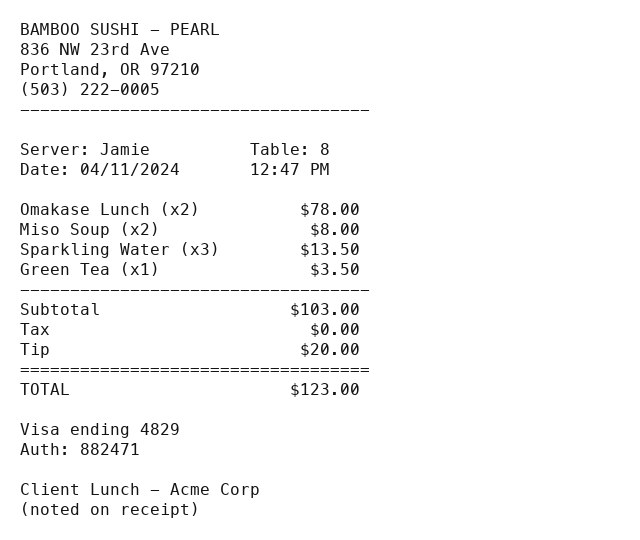
Great, I've read all 7 files. Here's what I found — let me now organize everything into a clean folder structure, rename the files properly, and generate your tax summary.
Now let me create the tax-ready summary:
Let me verify everything landed correctly:
All done. Here's what I did:
What was organized
All 7 files were renamed with a consistent YYYY-MM-DD_vendor_description_amount format and sorted into 4 category folders:
| Folder | Files | Subtotal |
|---|---|---|
invoices/ | Stripe, AWS, Adobe | $3,851.48 |
travel/ | Delta flight, Hilton hotel | $793.70 |
meals/ | Bamboo Sushi client lunch | $123.00 |
office-supplies/ | Office Depot (faded receipt) | ~$122.48 ⚠️ |
Total documented: $4,890.66 ($4,768.18 fully substantiated)
⚠️ Things that need your attention
-
The Office Depot receipt (
scan0042.png) is faded/cut off — I couldn't read the total, tax, or exact date. I estimated ~$122.48 from visible line items. You'll need to pull the Visa …29 statement for March 2024 to get the real number. -
The Bamboo Sushi client lunch is only 50% deductible under IRS rules — so $61.50 of the $123.00.
-
The Delta SFO trip (Feb 19–21) and the Hilton Portland stay (Feb 12–14) are different dates — make sure you can document the business purpose for each separately.
-
This only covers Jan–Apr 2024 — you'll need to track down May–December before filing.
Everything is in 2024-expenses/ with a full 2024_expense_summary.md you can hand directly to your CPA.
Permissions
| Scope | Description |
|---|---|
| filesystem:read | |
| filesystem:write |
SKILL.md
Invoice Organizer
This skill transforms chaotic folders of invoices, receipts, and financial documents into a clean, tax-ready filing system without manual effort.
When to Use This Skill
- Preparing for tax season and need organized records
- Managing business expenses across multiple vendors
- Organizing receipts from a messy folder or email downloads
- Setting up automated invoice filing for ongoing bookkeeping
- Archiving financial records by year or category
- Reconciling expenses for reimbursement
- Preparing documentation for accountants
What This Skill Does
-
Reads Invoice Content: Extracts information from PDFs, images, and documents:
- Vendor/company name
- Invoice number
- Date
- Amount
- Product or service description
- Payment method
-
Renames Files Consistently: Creates standardized filenames:
- Format:
YYYY-MM-DD Vendor - Invoice - ProductOrService.pdf - Examples:
2024-03-15 Adobe - Invoice - Creative Cloud.pdf
- Format:
-
Organizes by Category: Sorts into logical folders:
- By vendor
- By expense category (software, office, travel, etc.)
- By time period (year, quarter, month)
- By tax category (deductible, personal, etc.)
-
Handles Multiple Formats: Works with:
- PDF invoices
- Scanned receipts (JPG, PNG)
- Email attachments
- Screenshots
- Bank statements
-
Maintains Originals: Preserves original files while organizing copies
How to Use
Basic Usage
Navigate to your messy invoice folder:
cd ~/Desktop/receipts-to-sort
Then ask Claude Code:
Organize these invoices for taxes
Or more specifically:
Read all invoices in this folder, rename them to
"YYYY-MM-DD Vendor - Invoice - Product.pdf" format,
and organize them by vendor
Advanced Organization
Organize these invoices:
1. Extract date, vendor, and description from each file
2. Rename to standard format
3. Sort into folders by expense category (Software, Office, Travel, etc.)
4. Create a CSV spreadsheet with all invoice details for my accountant
Instructions
When a user requests invoice organization:
-
Scan the Folder
Identify all invoice files:
# Find all invoice-related files
find . -type f \( -name "*.pdf" -o -name "*.jpg" -o -name "*.png" \) -print
Report findings:
- Total number of files
- File types
- Date range (if discernible from names)
- Current organization (or lack thereof)
-
Extract Information from Each File
For each invoice, extract:
From PDF invoices:
- Use text extraction to read invoice content
- Look for common patterns:
- "Invoice Date:", "Date:", "Issued:"
- "Invoice #:", "Invoice Number:"
- Company name (usually at top)
- "Amount Due:", "Total:", "Amount:"
- "Description:", "Service:", "Product:"
From image receipts:
- Read visible text from images
- Identify vendor name (often at top)
- Look for date (common formats)
- Find total amount
Fallback for unclear files:
- Use filename clues
- Check file creation/modification date
- Flag for manual review if critical info missing
-
Determine Organization Strategy
Ask user preference if not specified:
I found [X] invoices from [date range]. How would you like them organized? 1. **By Vendor** (Adobe/, Amazon/, Stripe/, etc.) 2. **By Category** (Software/, Office Supplies/, Travel/, etc.) 3. **By Date** (2024/Q1/, 2024/Q2/, etc.) 4. **By Tax Category** (Deductible/, Personal/, etc.) 5. **Custom** (describe your structure) Or I can use a default structure: Year/Category/Vendor -
Create Standardized Filename
For each invoice, create a filename following this pattern:
YYYY-MM-DD Vendor - Invoice - Description.extExamples:
2024-03-15 Adobe - Invoice - Creative Cloud.pdf2024-01-10 Amazon - Receipt - Office Supplies.pdf2023-12-01 Stripe - Invoice - Monthly Payment Processing.pdf
Filename Best Practices:
- Remove special characters except hyphens
- Capitalize vendor names properly
- Keep descriptions concise but meaningful
- Use consistent date format (YYYY-MM-DD) for sorting
- Preserve original file extension
-
Execute Organization
Before moving files, show the plan:
# Organization Plan

## Proposed Structure
Invoices/ ├── 2023/ │ ├── Software/ │ │ ├── Adobe/ │ │ └── Microsoft/ │ ├── Services/ │ └── Office/ └── 2024/ ├── Software/ ├── Services/ └── Office/
## Sample Changes

Before: `invoice_adobe_march.pdf`
After: `2024-03-15 Adobe - Invoice - Creative Cloud.pdf`
Location: `Invoices/2024/Software/Adobe/`

Before: `IMG_2847.jpg`
After: `2024-02-10 Staples - Receipt - Office Supplies.jpg`
Location: `Invoices/2024/Office/Staples/`

Process [X] files? (yes/no)
After approval:
# Create folder structure mkdir -p "Invoices/2024/Software/Adobe" # Copy (don't move) to preserve originals cp "original.pdf" "Invoices/2024/Software/Adobe/2024-03-15 Adobe - Invoice - Creative Cloud.pdf" # Or move if user prefers mv "original.pdf" "new/path/standardized-name.pdf" -
Generate Summary Report
Create a CSV file with all invoice details:
Date,Vendor,Invoice Number,Description,Amount,Category,File Path
2024-03-15,Adobe,INV-12345,Creative Cloud,52.99,Software,Invoices/2024/Software/Adobe/2024-03-15 Adobe - Invoice - Creative Cloud.pdf
2024-03-10,Amazon,123-4567890-1234567,Office Supplies,127.45,Office,Invoices/2024/Office/Amazon/2024-03-10 Amazon - Receipt - Office Supplies.pdf
...
This CSV is useful for:
- Importing into accounting software
- Sharing with accountants
- Expense tracking and reporting
- Tax preparation
-
Provide Completion Summary
# Organization Complete! 📊

## Summary
- **Processed**: [X] invoices
- **Date range**: [earliest] to [latest]
- **Total amount**: $[sum] (if amounts extracted)
- **Vendors**: [Y] unique vendors

## New Structure
Invoices/ ├── 2024/ (45 files) │ ├── Software/ (23 files) │ ├── Services/ (12 files) │ └── Office/ (10 files) └── 2023/ (12 files)
## Files Created
- `/Invoices/` - Organized invoices
- `/Invoices/invoice-summary.csv` - Spreadsheet for accounting
- `/Invoices/originals/` - Original files (if copied)

## Files Needing Review
[List any files where information couldn't be extracted completely]

## Next Steps
1. Review the `invoice-summary.csv` file
2. Check files in "Needs Review" folder
3. Import CSV into your accounting software
4. Set up auto-organization for future invoices

Ready for tax season! 🎉
Examples
Example 1: Tax Preparation (From Martin Merschroth)
User: "I have a messy folder of invoices for taxes. Sort them and rename properly."
Process:
- Scans folder: finds 147 PDFs and images
- Reads each invoice to extract:
- Date
- Vendor name
- Invoice number
- Product/service description
- Renames all files:
YYYY-MM-DD Vendor - Invoice - Product.pdf - Organizes into:
2024/Software/,2024/Travel/, etc. - Creates
invoice-summary.csvfor accountant - Result: Tax-ready organized invoices in minutes
Example 2: Monthly Expense Reconciliation
User: "Organize my business receipts from last month by category."
Output:
# March 2024 Receipts Organized

## By Category
- Software & Tools: $847.32 (12 invoices)
- Office Supplies: $234.18 (8 receipts)
- Travel & Meals: $1,456.90 (15 receipts)
- Professional Services: $2,500.00 (3 invoices)

Total: $5,038.40

All receipts renamed and filed in:
`Business-Receipts/2024/03-March/[Category]/`

CSV export: `march-2024-expenses.csv`
Example 3: Multi-Year Archive
User: "I have 3 years of random invoices. Organize them by year, then by vendor."
Output: Creates structure:
Invoices/
├── 2022/
│   ├── Adobe/
│   ├── Amazon/
│   └── ...
├── 2023/
│   ├── Adobe/
│   ├── Amazon/
│   └── ...
└── 2024/
    ├── Adobe/
    ├── Amazon/
    └── ...
Each file properly renamed with date and description.
Example 4: Email Downloads Cleanup
User: "I download invoices from Gmail. They're all named 'invoice.pdf', 'invoice(1).pdf', etc. Fix this mess."
Output:
Found 89 files all named "invoice*.pdf"

Reading each file to extract real information...

Renamed examples:
- invoice.pdf → 2024-03-15 Shopify - Invoice - Monthly Subscription.pdf
- invoice(1).pdf → 2024-03-14 Google - Invoice - Workspace.pdf
- invoice(2).pdf → 2024-03-10 Netlify - Invoice - Pro Plan.pdf

All files renamed and organized by vendor.
Common Organization Patterns
By Vendor (Simple)
Invoices/
├── Adobe/
├── Amazon/
├── Google/
└── Microsoft/
By Year and Category (Tax-Friendly)
Invoices/
├── 2023/
│   ├── Software/
│   ├── Hardware/
│   ├── Services/
│   └── Travel/
└── 2024/
    └── ...
By Quarter (Detailed Tracking)
Invoices/
├── 2024/
│   ├── Q1/
│   │   ├── Software/
│   │   ├── Office/
│   │   └── Travel/
│   └── Q2/
│       └── ...
By Tax Category (Accountant-Ready)
Invoices/
├── Deductible/
│   ├── Software/
│   ├── Office/
│   └── Professional-Services/
├── Partially-Deductible/
│   └── Meals-Travel/
└── Personal/
Automation Setup
For ongoing organization:
Create a script that watches my ~/Downloads/invoices folder
and auto-organizes any new invoice files using our standard
naming and folder structure.
This creates a persistent solution that organizes invoices as they arrive.
Pro Tips
- Scan emails to PDF: Use Preview or similar to save email invoices as PDFs first
- Consistent downloads: Save all invoices to one folder for batch processing
- Monthly routine: Organize invoices monthly, not annually
- Backup originals: Keep original files before reorganizing
- Include amounts in CSV: Useful for budget tracking
- Tag by deductibility: Note which expenses are tax-deductible
- Keep receipts 7 years: Standard audit period
Handling Special Cases
Missing Information
If date/vendor can't be extracted:
- Flag file for manual review
- Use file modification date as fallback
- Create "Needs-Review/" folder
Duplicate Invoices
If same invoice appears multiple times:
- Compare file hashes
- Keep highest quality version
- Note duplicates in summary
Multi-Page Invoices
For invoices split across files:
- Merge PDFs if needed
- Use consistent naming for parts
- Note in CSV if invoice is split
Non-Standard Formats
For unusual receipt formats:
- Extract what's possible
- Standardize what you can
- Flag for review if critical info missing
Related Use Cases
- Creating expense reports for reimbursement
- Organizing bank statements
- Managing vendor contracts
- Archiving old financial records
- Preparing for audits
- Tracking subscription costs over time
FAQ
What does invoice-organizer do?
Automatically organizes invoices and receipts for tax preparation by reading messy files, extracting key information, renaming them consistently, and sorting them into logical folders. Turns hours of manual bookkeeping into minutes of automated organization.
When should I use invoice-organizer?
Use it when you need a repeatable workflow that produces text report, pdf document, image output.
What does invoice-organizer output?
In the evaluated run it produced text report, pdf document, image output.
How do I install or invoke invoice-organizer?
npx skills add https://github.com/composiohq/awesome-claude-skills --skill invoice-organizer
Which agents does invoice-organizer support?
Claude Code
What tools, channels, or permissions does invoice-organizer need?
It uses no extra tools; channels commonly include text, pdf, image; permissions include filesystem:read, filesystem:write.
Is invoice-organizer safe to install?
Static analysis marked this skill as medium risk; review side effects and permissions before enabling it.
How is invoice-organizer different from an MCP or plugin?
A skill packages instructions and workflow conventions; tools, MCP servers, and plugins are dependencies the skill may call during execution.
Does invoice-organizer outperform not using a skill?
About invoice-organizer
When to use invoice-organizer
You have a folder of PDFs and receipt images that need to be renamed and organized for taxes or reimbursement. You want a standardized filing structure by vendor, category, or date while preserving original documents. You need a CSV inventory of invoice metadata for accounting or audit preparation.
When invoice-organizer is not the right choice
You need live integration with accounting platforms, email providers, or cloud storage services. Your task is purely financial analysis rather than file extraction, renaming, and folder organization.
What it produces
Produces text report, pdf document and image output.
Install
npx skills add https://github.com/composiohq/awesome-claude-skills --skill invoice-organizerInvoke: Ask Claude Code to use invoice-organizer for the task.